What Gene.01’s Full-Body Tactile Skin Really Means for Companion Dolls
An Italian startup just demonstrated something the broader companion-product industry has been waiting for: a humanoid whose intelligence lives in its skin, not just its head. Here’s why that matters to every buyer and brand on our shelves — and what to realistically expect, and when.
What Generative Bionics Actually Built
Italian startup Generative Bionics unveiled its humanoid robot Gene.01 — featuring full-body tactile sensing and a physics-native AI architecture — at AMD Advancing AI 2026. The timing is deliberate: the company has been on a fast build cycle since its founding, and the public demonstration marks the transition from concept to working hardware.
The company claims the entire platform was assembled in just six months. That’s a remarkable engineering compression rate, and it tells us something important: the component ecosystem for distributed tactile sensing is now mature enough to be integrated at speed. This wasn’t possible five years ago.
Generative Bionics is a spin-off from Italy’s IIT, established in July 2024; in December 2025, the company raised €70 million in one of Europe’s largest deep-tech funding rounds in humanoid robotics. The round was led by CDP Venture Capital’s Artificial Intelligence Fund and supplemented by investors including AMD Ventures, Duferco, Eni Next, RoboIT, and Tether.
The company leverages two decades of robotics research conducted at the Italian Institute of Technology, where more than 60 advanced humanoid robot prototypes were designed, tested, and refined. That’s not startup hype — it’s an institution’s worth of tactile-sensing science dropped into a commercial chassis. This research approach is detailed in a paper titled “Towards shared embodied intelligence in humanoid robots through optimization, development and testing of the human-aware ergoCub robot,” recently published in Nature Machine Intelligence in July 2026.
Founded July 2024
IIT spin-off with 20+ years of embodied robotics research baked in from day one.
€70M Raised
One of Europe’s largest humanoid deep-tech seed rounds, backed by AMD Ventures and others.
6-Month Build Cycle
Concept to fully functional sensorized humanoid in half a year — proof the supply chain is ready.
Peer-Reviewed Basis
The underlying methodology is published in Nature Machine Intelligence — not just a trade show demo.
The Four Senses of Gene.01’s Smart Skin
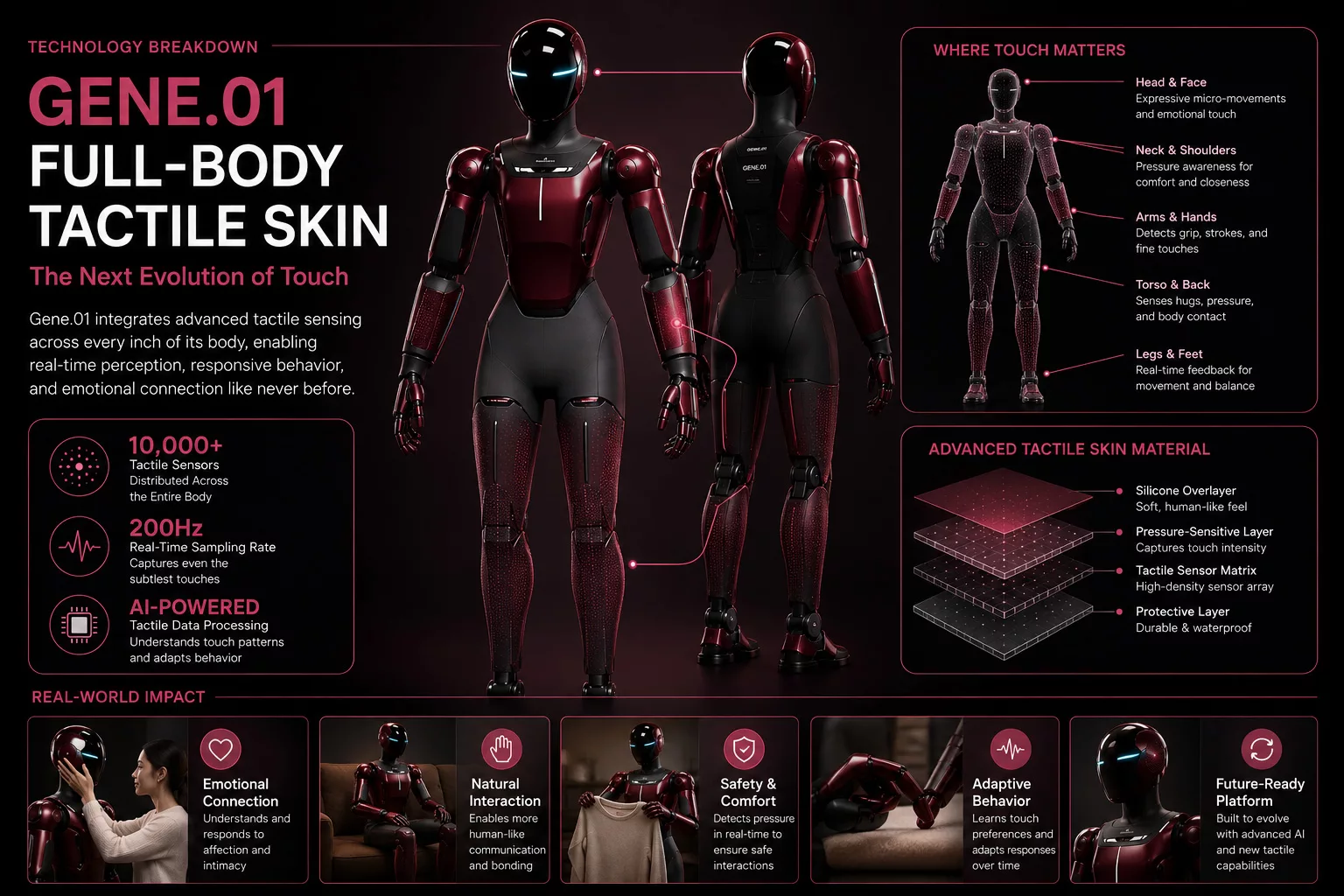
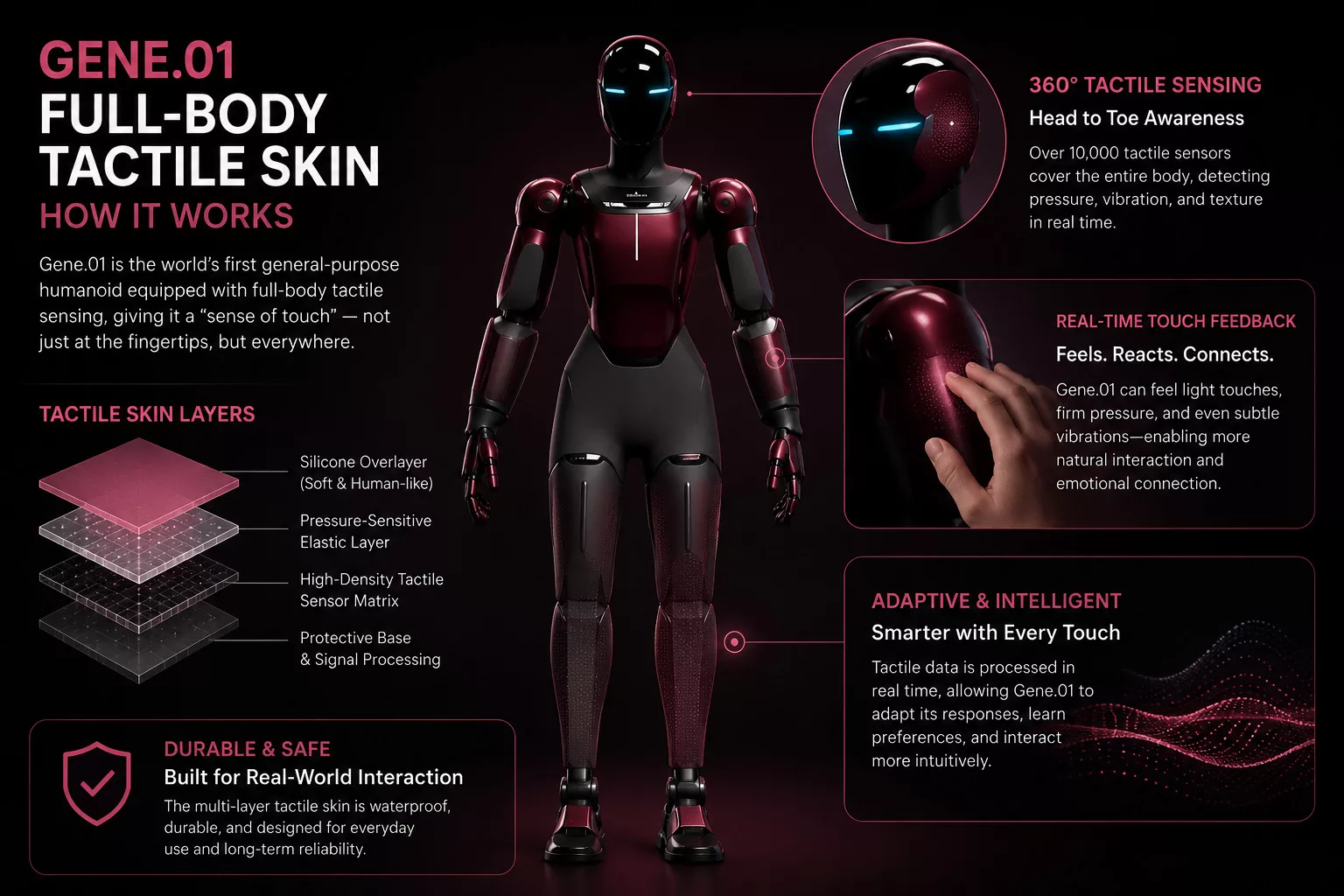
Most discussion around companion robots focuses on two capabilities: talking and moving. Gene.01’s real contribution is a third dimension: feeling. Unlike conventional humanoids that primarily rely on vision, Gene.01 features a distributed multimodal “smart skin” covering its body. The architecture is more interesting than a simple touch sensor.
In Gene.01, design integrates whole-body tactile sensors so it is not an aesthetic layer added after engineering, but an active component of intelligence and safety. The full-body tactile skin is a distributed network of touch and force sensors that allows the robot to perceive contact, pressure, and micro-interactions across its entire surface — making touch a primary channel of intelligence for continuous adaptation in real-world environments.
| Sensing Modality | What It Detects | How It’s Used in Gene.01 | Closest Companion-Doll Analog Today |
|---|---|---|---|
| Touch | Contact pressure across whole body | Identify where & how hard a human touches the robot | Localized touch sensors (usually chest/torso only) |
| Temperature | Thermal gradient on skin surface | Distinguish human warmth from ambient heat | Fixed internal heating elements (~37 °C body warmth) |
| Proximity | Pre-contact human presence | Robot adjusts behavior before physical contact | Not yet commercially deployed in dolls |
| Force | Grip strength & pressure gradient | Learn tasks via physical demonstration, not just video | Not yet commercially deployed in dolls |
Force sensing allows people to teach tasks by demonstrating not only motion, but also the force required — a capability that helps address problems video-only learning cannot solve, such as how to tightly grip an object. For the companion market, that translates to something significant: a doll that could learn the exact pressure a user prefers through physical interaction rather than a settings menu.
Gene.01 is powered by a suite of AMD CPUs, GPUs, and FPGAs that handle the immense data flow from the tactile skin and manage real-time motion control. The compute-in-body design is the key architectural shift: processing happens near the sensor, not after a round trip to a central brain. That lowers latency and makes touch response feel immediate rather than mechanical — a crucial distinction for companion applications.
Industrial Robot vs. Companion: The Gap Table
Gene.01 is explicitly an industrial product. Generative Bionics does not label Gene.01 as a universal humanoid, focusing instead on adaptation for specific verticals. The first industrial configuration is being prepared with Fincantieri for shipyard tasks, including a welding humanoid for complex shipbuilding environments. So where does that leave companion applications?
The honest answer is: further ahead on the roadmap than they were six months ago, but not at the consumer shelf yet. The gap is real, and buyers deserve a clear view of it.
| Dimension | Gene.01 (Industrial) | Premium AI Companion Doll (2026) | Gap Severity |
|---|---|---|---|
| Skin touch sensing | Whole-body distributed skin | Localized zones (chest, face) | 🔴 High |
| Temperature sensing | Active thermal detection | Passive heating elements only | 🟠 Medium |
| Proximity awareness | Pre-contact detection | Not deployed commercially | 🔴 High |
| Force / grip learning | Full force-feedback loop | Not deployed commercially | 🔴 High |
| Conversational AI | Functional but industrial-focus | NLP-driven, emotionally adaptive | 🟢 Companion leads |
| Physical realism / materials | Hard-shell industrial chassis | Medical-grade TPE/silicone skin | 🟢 Companion leads |
| Body heating | Not a stated feature | ~37 °C internal heating standard | 🟢 Companion leads |
| Price point | Enterprise / undisclosed | Consumer ($1,500–$8,000 range) | 🟢 Companion leads |
Three Direct Impacts on the Doll Market
Gene.01 is an industrial robot, yes. But every capability it demonstrates is a technology that suppliers in our ecosystem — WM, 6Ye, SY, YL, Starpery, XTDoll — are actively watching. Here is our read on the three most concrete near-term effects.
| Impact | What Changes | Estimated Arrival in Premium Dolls | Confidence |
|---|---|---|---|
| 1. Zone Expansion | Touch sensors move from 2-3 localized zones to full-torso coverage | 1–2 years | High |
| 2. Thermal Feedback Loop | Static heating upgrades to responsive thermal regulation (warms where touched) | 2–3 years | Medium |
| 3. Proximity & Pre-Touch Awareness | Doll detects approach before contact and shifts posture/audio response | 3+ years | Lower (compute cost) |
Impact 1 — Zone expansion is already in motion. Humanoid robots with advanced sensory capabilities are increasingly demanded for empathetic, close-contact interactions with humans, and electronic skin (e-skin) is a key enabling technology for such tactile perception. The academic pipeline feeding into commercial manufacturing has never been more active, and our brands source from factories that monitor this research closely.
Impact 2 — Thermal feedback loops represent the most natural next step for companion products specifically. Thermal regulation technology — heated skin — is cited as a major driver of user satisfaction in current-generation products, and the Gene.01 architecture demonstrates that temperature sensing and regulation can coexist in the same skin layer. Responsive warmth — not just static warmth — is the upgrade buyers will feel most immediately.
Impact 3 — Pre-touch proximity is the most transformative and the furthest out. Generative Bionics claims this enhances safety by allowing the robot to sense a person’s presence before contact and adjust its behavior accordingly. In a companion context, that means a doll that shifts into an attentive posture when you enter the room — before you say a word or make physical contact. That’s a qualitative leap in presence, but it demands onboard compute that is currently too costly and power-hungry for a non-industrial product.
Where Premium Dolls Are Right Now
Before buyers get swept up in the Gene.01 vision, it’s worth being precise about how far the companion market has already traveled. Today’s premium AI-integrated dolls are not passive products. Premium models feature motorized movement, internal heating, touch-responsive sensors, and conversational AI. The foundations are there; Gene.01 shows us the ceiling.
| Feature | Current Status | User Benefit | Gene.01 Equivalent |
|---|---|---|---|
| Touch sensors (localized) | ✅ Commercially available | Moaning / audio response to touch | Whole-body version of this |
| Body heating (~37 °C) | ✅ Commercially available | Realistic skin warmth | Active thermal sensing layer |
| Voice / NLP AI | ✅ Commercially available | Conversation, memory, personality | Industrial-grade voice (less companion-optimized) |
| Facial movement / expression | ✅ Entry-level to advanced | Eye contact, smiling, emotional cues | Not a Gene.01 focus |
| Full-body distributed touch | 🔄 In development / early stage | Responsive across entire body surface | Already deployed in Gene.01 |
| Pre-contact proximity sensing | ❌ Not yet in consumer products | Doll responds before you touch it | Deployed in Gene.01 |
This is the honest picture: the companion market has excellent fundamentals and a clear technological ceiling now visible in Gene.01. Buyers purchasing today are not buying yesterday’s technology — they’re buying the best available commercial product while the next wave is being engineered. The global AI sex dolls market was valued at USD 465 million in 2024 and is projected to grow from USD 556 million in 2025 to USD 1,549 million by 2032, exhibiting a CAGR of 19.4% during the forecast period. That growth is being driven precisely by the kind of innovation Gene.01 exemplifies.
Buyer Roadmap: Now vs. 3 Years Out
We run an authorized robot and AI doll collection for exactly this reason: to help buyers make time-aware decisions. If you want what Gene.01’s tactile architecture points toward, you are looking at a 3–5 year hardware cycle before that level of sensing reaches consumer companion products at reasonable price points. So what should you do today?
| Buyer Priority | Best Action Now (2026) | What to Watch For (2027–2029) |
|---|---|---|
| Maximum realism today | Premium silicone doll with body heating + touch-sensitive zones | Full-torso touch expansion from current brands |
| AI companion experience | AI head system with NLP, memory, and voice | Touch-informed AI that adapts to physical interaction history |
| Best-available sensing | Doll with localized touch sensors + active heating | Responsive thermal skin (warms to touch zone) |
| Investment / future-proofing | Modular platform (upgradeable heads / inserts) | Brands releasing sensor upgrade kits for existing bodies |
| Curiosity about robotics | Read our UBTECH U1 analysis for parallel context | Gene.01-derived sensing entering companion sector |
The most important framing: Gene.01 validates the direction, not the timeline. Gene.01 pioneers a Physical AI approach where intelligence is distributed through the body, not only the brain — with full-body tactile sensing and advanced onboard computing aimed at safe collaboration in complex environments. For companion buyers, “safe collaboration in complex environments” simply translates to “a doll that genuinely feels your touch anywhere on its body and responds intelligently.” That’s the north star this technology is pointing at.
We’ve watched this progression for almost a decade as an authorized multi-brand retailer since 2016 with 851 verified Yotpo reviews at 4.7 stars. The pattern is consistent: industrial robotics demonstrates capability 3–5 years before consumer companion products adopt it. Gene.01’s smart skin is on that clock now.
Frequently Asked Questions
What exactly is Gene.01’s “smart skin” and how does it differ from a simple touch sensor?
A traditional touch sensor detects contact at a single point and sends a binary signal (touched / not touched). Gene.01’s smart skin is a distributed multimodal network covering the robot’s entire body surface. It detects four distinct data streams simultaneously: touch, temperature, proximity, and force — and it processes that data in real time using onboard AMD compute hardware distributed throughout the body, not just in a central processor. The result is a system that can sense a human approaching, feel exactly where and how hard contact is made, measure the thermal signature of a hand versus the ambient room temperature, and measure grip force — all at once, all over the body.
Can I buy a sex doll with full-body tactile sensing right now?
Not with the full-body coverage that Gene.01 demonstrates, no. Current premium companion dolls from brands like WM, SY, Starpery, and XTDoll feature localized touch sensors (typically covering chest and sometimes torso zones) that trigger audio or heating responses when contacted. Body heating is widely available and works well. Full-body distributed touch sensing at the Gene.01 level is an industrial-grade technology that has not yet been miniaturized and priced for consumer companion products. Based on historic technology adoption cycles, we estimate meaningful full-torso sensing in premium consumer companion dolls is approximately 1–3 years away. Our robot and AI doll collection reflects the current best available.
Does the Gene.01 announcement change what I should buy today?
For most buyers, no — and here’s why. Gene.01’s sensing capabilities are about 3–5 years from commercial companion-product integration. The dolls available today offer the best physical realism, warmth, and AI companionship that current technology allows. Waiting for “the next big thing” in this category has never been a sound strategy — the technology horizon keeps advancing. If you want the best experience available now, invest in a premium platform with body heating, localized touch response, and an AI head system. If you want to future-proof, choose a brand that uses modular, upgradeable architectures. Our UBTECH U1 analysis covers the same timing question from the robot-companion angle.
What is “physics-native AI” and why should companion-doll buyers care?
Physics-native AI is an architectural approach where the software that controls a robot is designed around the physical properties of the body — its weight distribution, skin compliance, joint range — rather than treating those as separate engineering constraints. In Gene.01, this means the AI and the hardware are co-optimized from the start. For companion buyers, this matters because it represents the design philosophy that will eventually produce dolls whose responses feel genuinely physical and intuitive rather than mechanically delayed. When a premium companion doll’s touch response lags a fraction of a second or feels disconnected, that’s the absence of physics-native design. Gene.01 demonstrates it is solvable.
Which current SSD product categories benefit most from the tactile-sensing roadmap?
Two categories stand to gain the most when full-body sensing arrives. First, AI/robot companion dolls — because distributed touch data feeds directly into the conversational and behavioral AI layer, allowing the companion to respond to physical interaction in ways that feel natural. Second, products with specialized tactile features already baked in — such as our Real Oral System collection and touch-sensitive torso designs — because they share the same engineering vocabulary as what Gene.01 is scaling to whole-body coverage. Explore our robot and AI doll hub for the current best available in each category.
Explore the Best AI & Robot Companion Dolls Available Today
We’re an authorized multi-brand retailer since 2016 — 851 verified Yotpo reviews at 4.7 stars. Browse the tech-forward companion products available right now while the next generation is being engineered.